The one-year anniversary of Carlsbad desalination plant provides an opportunity to look at its positive impact in the region, writes Mark Muir of the San Diego County Water Authority.
Archives for 2016
NEWS RELEASE: Ground-breaking $1.2bn Project to Deliver Urgent Water Infrastructure Works Across Kurdistan
British water engineering company, Biwater, have been awarded a USD $1.2 billion contract by the Kurdistan Regional Government to meet vital water supply and sanitation needs.
Surrey, UK – 8 December 2016: Biwater have been contracted to deliver water and wastewater treatment solutions for the cities of Erbil and Sulaimani in the Kurdistan Region of Iraq. Works will alleviate the current strain on existing infrastructure and reduce the region’s reliance on dwindling groundwater reserves to deliver long-lasting environmental benefits.
“Since Biwater was founded in 1968, we have delivered many large international water projects across the globe, including strategic turnkey solutions throughout the Middle East. The signing of this contract in Kurdistan is a major landmark in providing technological and financial solutions that address complex water-related challenges in the region,” said Sir Adrian White, CBE, Chairman, Biwater.
As a part of this project, Erbil will be provided with a 600,000 m3/day state-of-the-art water treatment plant, while Sulaimani will benefit from water treatment plant upgrades and the construction of cutting-edge wastewater treatment works and sludge treatment facilities.
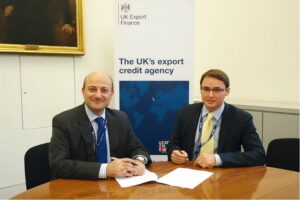
Present at a signing event in London today, Alastair White, Deputy Chairman, Biwater, extended his thanks to those involved saying, “Biwater is very grateful for the support of UK Export Finance (UKEF), the Department for International Trade (DIT) and Her Majesty’s Government teams in Erbil and Baghdad, who have been instrumental in bringing the project to fruition.”
The London-based event was arranged to mark the signing of a loan to fund the project’s Development Works, which will include all relevant site surveys, social and environmental impact assessments and detailed designs. Development Works will run for a period of 6-12 months before construction.
The loan for the Development Works is being financed by UK Export Finance (UKEF). J.P. Morgan is acting as the Facility Agent and Mandated Lead Arranger for this initial loan on behalf of UKEF to The Kurdistan Regional Government.
Rt Hon. Greg Hands MP, Minister for Trade and Investment, said, “This is great news for Biwater and for British exports, and I am delighted that UKEF is financing this hugely important contract. It shows what is possible when British technical excellence receives the right government support at the right time. The project will bring much needed benefits to Kurdistan and also offer substantial opportunities for supply chain companies based here in the UK.”
Welcoming the water project and the loan agreement, Kurdistan Prime Minister Nechirvan Barzani said, “This is a significant step that will help improve the daily lives of the citizens of Erbil and Sulaimani. It is also the first time the UK government has provided a direct loan to the KRG to boost our infrastructure. We hope this initial loan will pave the way to attracting finance for the next stage of this important project. We also appreciate the high-level backing this project has received from the UK government, highlighting the close and fruitful relationship between the UK and the Kurdistan Region.”
– ENDS –
Photo:
|
Contact:
Hayley Thompson
Communication and Marketing Manager
Office: +44 (0)1306 746169
Mobile: +44 (0)7867 456986
Email: hayley.thompson@biwater.com
About Biwater:
Biwater provides large-scale water and wastewater solutions for cities across the world. Since its inception in 1968, Biwater has gained recognition for its innovative approaches aimed at overcoming the world’s most pressing water-related challenges. Throughout its history, the company has grown to meet the demands of over 90 countries experiencing severe water stress, compounded by burgeoning populations – financing, consulting, process engineering, designing, constructing, operating, maintaining and owning water facilities – in both rural and urban environments.
El Pasoans help Provide Clean, Desalinated Water Abroad
For many of us in El Paso, save for a lapse in payment or water main break, we expect water to come out of the faucet when we turn on our taps. But for many in Tegucigalpa, Honduras, potable water is a precious commodity…
Bureau of Reclamation Seeks Applicants for Four Water Treatment Research Funding Opportunities
Desalination and Water Purification Research and Title XVI Water Reclamation and Reuse Research applications are now being accepted.
Desal Getting Bigger in Texas
This month’s column was written in collaboration with Paul Choules, president of the Texas Desalination Association. Shared with the permission of GWI.
Written by Amanda Brock.
There are great opportunities in Texas for companies that are able to utilise their desal technologies in multiple applications. But this requires the ability to understand and navigate the complexities of the Texas market-place, and take into consideration the huge footprint of the state itself. Even with the slowdown in the O&G sector, in 2015 Texas remained the top destination for one-way moving truck rentals. Houston, San Antonio and Austin ranked as three of the top five destinations nationally, and as many as 345 people still move to Texas every day.
Understanding the connection between desal and Texas requires an understanding of the upstream and downstream O&G sector. Texas has 29 operating refineries processing approximately 5.8 million barrels of crude oil per day. Houston, soon to be the third-largest city in the US, accounts for over 40% of the nation’s base petrochemical capacity on its own. Plants in Freeport, Beaumont, Corpus Christi and other Texas cities and towns make the state the largest petrochemical market in the US.
Watching the slowdown in the upstream O&G market – including the unconventionals market – is concerning, but there continues to be a significant need for desal technologies relating to the treatment of water used and reused for frac’ing and produced water.
The Texas Water Development Board reports more than 100 desalina-tion plants installed in Texas. Most are small or intermittent-type facilities, but there are three large facilities in-state: the Kay Bailey Hutchison plant in El Paso, which can produce up to 104,000m3/d of fresh water, the Southmost Region-al Water Authority Desalination Plant (28,400m3/d) for south Texas, and a new brackish water desal plant currently under construction in San Antonio. Phase 1 of the San Antonio Water System (SAWS) desalination plant is set to be completed this year, and will produce 10 million gallons (37,850m3) of fresh water daily.
All desalination facilities in Texas currently use brackish groundwater. There were no seawater plants in operation in Texas as of October 2016, although several are planned, and at least one is under construction at a petrochemical facility near Corpus Christi. But that is about to change.
Cities and towns throughout Texas such as Galveston, Corpus Christi, Free-port, Baytown, Conroe, Katy and Odessa are all looking at desal options as part of their overall water portfolios. Katy, a suburb of Houston, recently contracted a 2MGD (7,570m3/d) brackish water desal plant to help with groundwater subsidence by taking water from a deep brackish water aquifer. Other cities and towns that have an industrial base, such as Corpus Christi and Freeport, are looking at ways to reduce the overall cost to install desal facilities by having industrial partners participate in the projects. Desal technologies are also being used for direct and indirect potable water reuse projects.
The challenge for companies is in appreciating the complex market. For the municipal sector, understanding 1) the regulatory and permitting requirements; 2) who to deal with at all levels – local, state and federal – and 3) the contracting mechanisms used to execute projects add to the complexity of developing desal projects in Texas. The current go-to method for contracting municipal projects in Texas is DBB, although other methods such as CM@R, DB and PPPs are being considered.
The interest level continues to be high among our elected officials, includ-ing Texas Governor Greg Abbott. He and other politicians recently travelled to Israel to visit desal facilities and witness the positive effects of desal in Israel. There are many reasons why the Texas market is attractive to desal-related companies, and many companies have been successful here. The common denominators in these successes were patience, a diverse technical portfolio, the capability to operate in the industrial and municipal markets, and the ability to build relationships.
- 1
- 2
- 3
- 4
- Next Page »